
November 2025 UK Economy and Labour Market Report

The UK labour market is showing early signs of stabilising. Payrolled employment is still easing, but the pace is slowing and vacancies are levelling off.

At a glance

  • Unemployment rate: 5%, up 0.3 percentage points on the quarter (Jul–Sep 25) — 1.789 million people
  • UK employment rate: 75%, down 0.2 percentage points (Jul–Sep 25)
  • Economic inactivity: largely unchanged at 21%
  • Earnings growth: 4.6% excluding bonuses (quarter ending Sep 25)
  • Inflation (CPI): 3.6% (Oct 2025), down from 3.8% in September
  • Bank Rate: 4%
  • Job vacancies: 723,000 (Aug–Oct 2025), up 6,000 on the quarter
  • New job postings: 754,359 in Oct 25, up 2.1% on September

Data source: Office for National Statistics, Recruitment & Employment Confederation, Change Specialists Ltd.

About these figures. These are the statistics as the Office for National Statistics published them at the time of this report. ONS routinely revises Labour Force Survey estimates afterwards, so today’s figures for the same period may differ slightly. For the latest official figures, see our UK labour market tracker, which is refreshed daily direct from ONS and the Bank of England.

What it means

Demand is still there. An estimated 723,000 vacancies and 754,000 new job postings in October show continued demand for workers, even as unemployment rises.

Inflation is easing but not solved. At 3.6% it is down from summer highs, yet still well above the Bank of England’s 2% target. Businesses face higher costs and recruitment challenges, though stable inflation supports consumer spending.

Flexible resourcing is doing the heavy lifting. Many organisations remain cautious about permanent hires, yet transformation and digital initiatives cannot wait. Interim and contract talent provides the bridge — delivering specialist capability, maintaining momentum and managing risk without long-term cost commitments.

Written by Julian Brown, Practice Director, Change Specialists.

October 2025 UK Economy and Labour Market Report

With planning season in full swing, many organisations are reviewing their 2026 transformation portfolios, budgets and resources. Given the challenging UK economy, aligning investment, capability and priorities matters more than ever.

At a glance

  • Unemployment rate: 4.8%, up 0.2 percentage points on the quarter (Jun–Aug 25) — 1.74 million people
  • UK employment rate: 75.1%, down 0.2 percentage points (Jun–Aug 25)
  • Economic inactivity: largely unchanged at 21.0%
  • Earnings growth: 4.7% excluding bonuses (quarter ending Aug 25)
  • Inflation (CPI): 3.8% (Aug 2025), against the Bank of England’s 2% target
  • Bank Rate: 4%
  • Job vacancies: 717,000 (Jul–Sep 2025), down 1.3% on the quarter
  • New job postings: 742,967 in Sep 25, up 11.3% on August

Data source: Office for National Statistics, Recruitment & Employment Confederation, Change Specialists Ltd.

About these figures. These are the statistics as the Office for National Statistics published them at the time of this report. ONS routinely revises Labour Force Survey estimates afterwards, so today’s figures for the same period may differ slightly. For the latest official figures, see our UK labour market tracker, which is refreshed daily direct from ONS and the Bank of England.

What it means

Hiring is warming up. New job postings rose 11.3% in September as the market picked up after the summer.

The hiring that is happening is targeted. Demand is concentrated in digital, infrastructure and transformation roles, suggesting a shift towards skills-focused workforce strategies rather than broad headcount growth.

Competition for critical skills continues. Organisations are competing for scarce capability while managing operational and financial pressure. Strategic alignment of people and operational plans will be essential to navigate continuing economic uncertainty.

Written by Julian Brown, Practice Director, Change Specialists.
September 2025 UK Economy and Labour Market Report

The UK labour market continues to cool. Unemployment has risen to 4.7% and economic inactivity has fallen to 21.1%, suggesting more people are staying in or returning to work.

At a glance

  • Unemployment rate: 4.7% (May–Jul 2025) — 1.67 million people
  • UK employment rate: 75.2%, up slightly on the quarter (May–Jul 25)
  • Economic inactivity: down to 21.1%
  • Earnings growth: 4.8% excluding bonuses (quarter ending Jul 25); total pay up 4.7%
  • Inflation (CPI): 3.8% (Aug 2025), against the Bank of England’s 2% target
  • Bank Rate: 4%
  • Job vacancies: 728,000 (Jun–Aug 2025), down 1.4% on the quarter
  • New job postings: 661,639 in Aug 25, down 3.8% on July

Data source: Office for National Statistics, Recruitment & Employment Confederation, Change Specialists Ltd.

About these figures. These are the statistics as the Office for National Statistics published them at the time of this report. ONS routinely revises Labour Force Survey estimates afterwards, so today’s figures for the same period may differ slightly. For the latest official figures, see our UK labour market tracker, which is refreshed daily direct from ONS and the Bank of England.

What it means

The cooling trend continues. Payrolled employees fell further, unemployment rose and vacancies declined again, particularly in larger businesses. Total weekly hours increased, reflecting heavier workloads for those in work.

The signals are mixed, not uniformly negative. The employment rate edged up and nominal wage growth remains strong, even as structural pressures point to a softer market.

What it means for you. Employers benefit from increased candidate availability. Work seekers need to sharpen skills and adaptability to stay competitive. As decision-makers return after the summer, expect restrained hiring and wage strategies — with some organisations already shifting towards contract and interim resource.

Slower GDP growth and cautious business investment point to a measured pace. It matters that these figures do not dampen innovation or digital transformation.

Written by Julian Brown, Practice Director, Change Specialists.

June 2025 UK Labour Market Update

Employer confidence continues to soften, but the pace of decline in job vacancies has slowed — the weakest rate of vacancy contraction since September 2024.

At a glance

  • Unemployment rate: 4.6% (February to April 2025)
  • Job vacancies: 736,000 (March to May 2025), down 63,000 on the quarter and 59,000 below January–March 2020 levels
  • Payrolled employees: 30.2 million — early May estimates down 109,000 on the month and 274,000 on the year
  • Average total pay growth: 5.3% including bonuses (Feb–Apr 2025)
  • Pay growth in real terms: up 1.5% (Feb–Apr 2025)
  • Claimant count: 1.735 million (May 2025)

Data source: Office for National Statistics, Recruitment & Employment Confederation, Change Specialists Ltd — June 2025.

About these figures. These are the statistics as the Office for National Statistics published them at the time of this report. ONS routinely revises Labour Force Survey estimates afterwards, so today’s figures for the same period may differ slightly. For the latest official figures, see our UK labour market tracker, which is refreshed daily direct from ONS and the Bank of England.

What it means

We may be approaching a turning point in the labour market’s downturn, potentially for contract work — though caution remains.

Many organisations are still not replacing leavers in order to manage costs, which points to ongoing uncertainty in workforce planning.

The labour market closely tracks the broader economy, and these figures reflect the continued impact of tough winter months and ongoing inflationary pressure.

Written by Julian Brown, Practice Director, Change Specialists.

Change Specialists UK Labour Market Report cover, June 2024

June 2024 UK Labour Market Update

You may be aware that Change Specialists produce a monthly UK Labour Market update highlighting headline statistics relating to the UK market. Here’s our update for June 2024 in 45 secs 👇

UK Labour Market Update Summary

The number of active job adverts reflects continuing steady demand for workers despite slow progress in the wider economy.

Employers remain intent on hiring and investing in their business, but are acting more cautiously because of economic and political uncertainty. This is expected to change as inflation stays low and interest rates drop over the summer.

Interested in receiving monthly UK labour market updates direct to your inbox? If you have found our Labour Market overview insightful drop us a message – info@changespecialists.co.uk or follow our company page on LinkedIn to receive regular updates.

Change Specialists work with clients across multiple sectors to support them to achieve successful outcomes for business change and digital transformation programmes.

Contact us to discuss your pending or current programmes of work.

May 2023 UK Labour Market Update

Our popular UK Labour Market update is now available to watch in 50 seconds – click below for an instant update!

Signs are emerging that the UK job market is cooling. However, growth in employee average total pay is up 5.8% January to March 2023.

If you would like to discuss the latest UK labour market trends, or receive a copy of future Labour Market reports direct to your inbox, contact us or follow our LinkedIn page.

Change Specialists – The Change People

UK Labour Market Update

January 2023 UK Labour Market Update

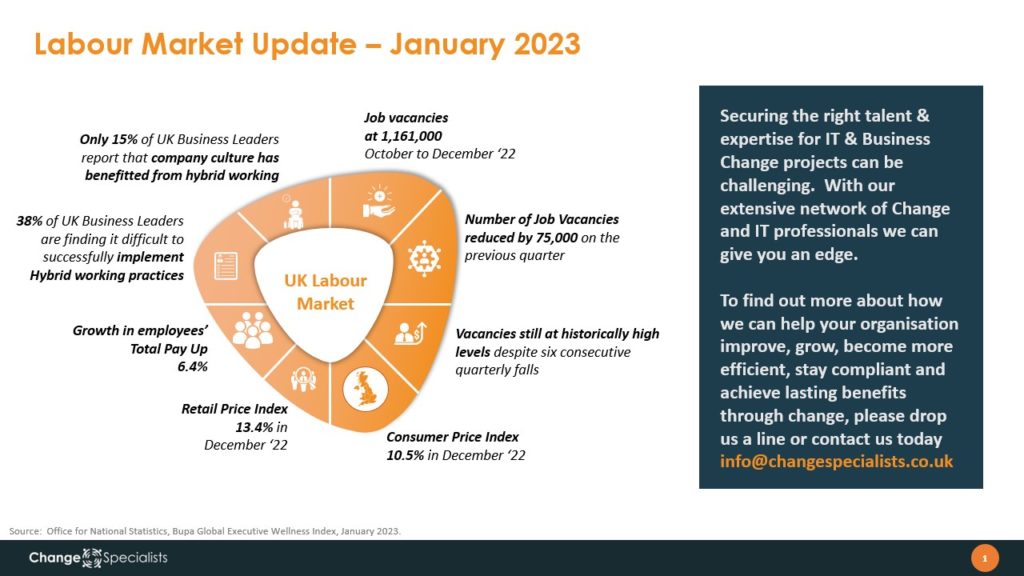
Hot off the press! UK Labour Market Update, our snapshot of how the UK Labour market is performing, and associated data.

A recent slowdown in hiring reflects greater economic uncertainty, rising costs and ongoing candidate shortages.

Our findings highlight the challenges facing organisations in attracting and retaining the skills and capabilities they need across all disciplines, including driving Change and IT and digital programmes. 

If you would like to discuss the latest labour market trends, or receive a copy of future Labour Market reports direct to your inbox, contact us or follow our LinkedIn page.

Change Specialists – The Change People

UK Labour Market Update

Labour Market Update January 2023